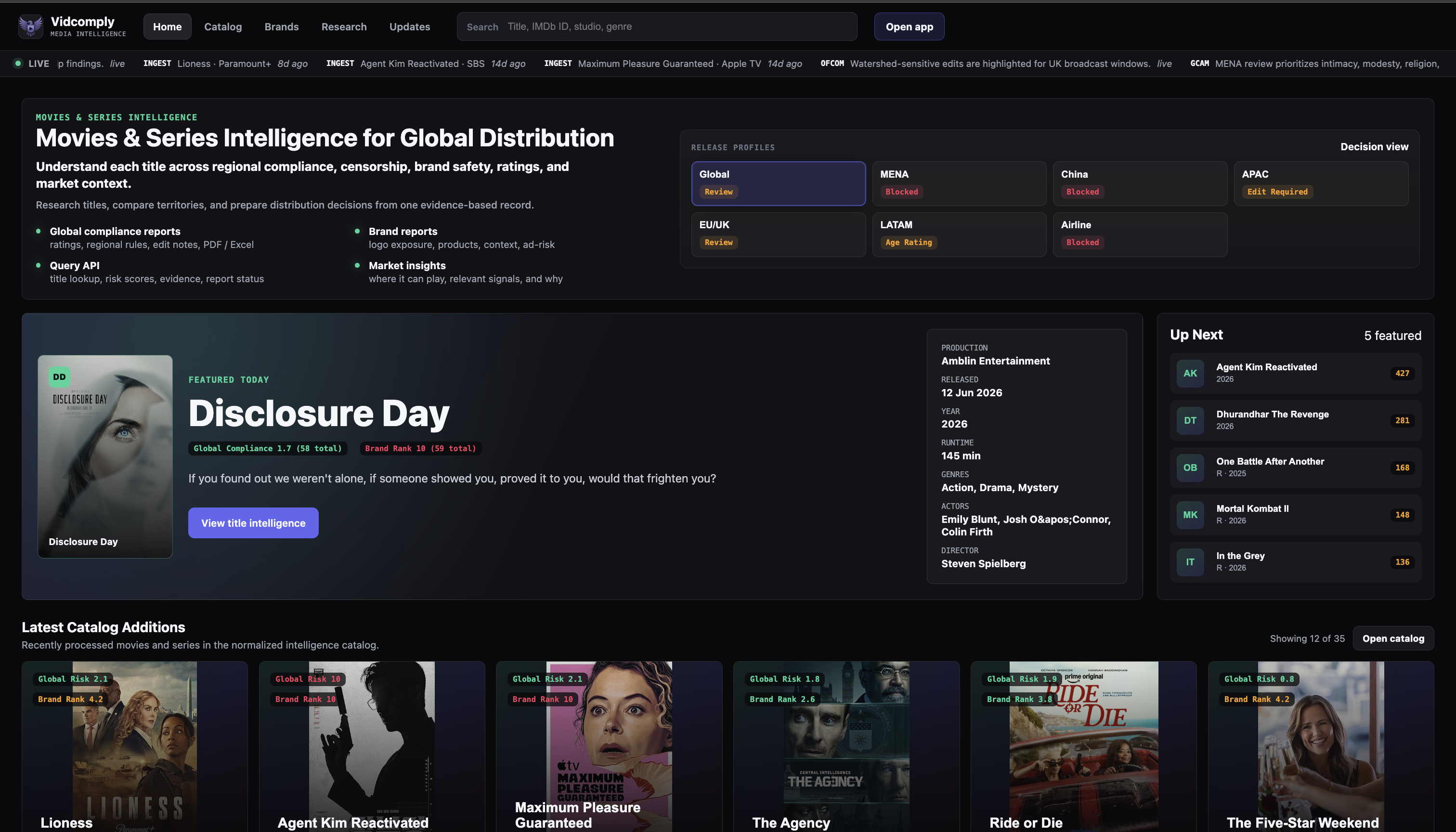
VidComply Intelligence is a publicly browsable title database built specifically for video compliance, regional distribution and brand intelligence. It extends familiar movie and series metadata with approved scene-level evidence, exact timecodes, representative frames, dialogue or subtitle context, ratings, market profiles and query-ready data.
A title can be commercially attractive and operationally expensive
Most acquisition decisions begin with familiar information: synopsis, cast, genre, release date, source rating, distributor and audience potential. That tells a buyer what the title is. It does not reveal every scene that may create edits, disclaimers, rating changes, airline restrictions, advertising conflicts or delayed delivery.
Those questions are often discovered after rights, schedules and launch plans are already in motion. Teams then pay again in review hours, localisation, edit preparation, alternate-version management and missed release windows.
The purpose of a compliance title database is to move that knowledge earlier. A buyer should be able to ask not only “Do we want this title?” but also:
- What compliance-sensitive material is actually present?
- Where does each occurrence begin and end?
- Which findings are strong, mild or informational?
- How do the relevant signals change by destination?
- Which visible brands may require clearance, suitability or sponsor review?
- What rating, scheduling, subtitle or version work may follow?
Think IMDb for compliance—but with evidence inside the programme
IMDb-style identifiers are useful because buyers, studios and data systems need a common way to recognise the same work. Vidcomply uses those identifiers where available, then adds an operational layer that ordinary entertainment metadata does not contain. Vidcomply is not affiliated with or endorsed by IMDb.
| Layer | What teams can inspect |
|---|---|
| Title identity | Movie or series metadata, version context, IMDb ID, release information, people, studios and distributors. |
| Scene evidence | Normalised issue, category, severity, source modality, exact timecode and representative frame. |
| Language | Dialogue, transcript or subtitle evidence attached to the relevant cue or scene where approved for publication. |
| Regional profiles | Territory-specific matches and proposed actions for MENA, China, APAC, EU/UK, LATAM, airline/IFE and configured profiles. |
| Ratings & scheduling | Source classifications, rating drivers, broadcast suitability, watershed or daypart context and OTT audience controls. |
| Brand intelligence | Detected logos, products, signage, vehicles, clothing, devices and sponsor marks with prominence and scene context. |
| Data access | Public search and catalogue exploration, machine-readable overview data, and approved enterprise queries or APIs. |
See the issue, not only the label
A useful record does not stop at “violence,” “alcohol” or “brand detected.” Where approved for public display, the record can show a representative screenshot, exact timecode, scene description, subtitle or dialogue context, severity and the profile that made the evidence relevant.
Open a public title record →Browse current title and episode reports
Published coverage varies by title. The Elle series record and Agent Kim Reactivated series record link to episodes with published reports; neither should be read as a complete season guide. The Office Romance title record shows a source R rating alongside a separate preliminary Mature advisory. For the reasoning and limits behind those labels, see the Office Romance rating analysis.
One title does not have one universal compliance answer
A single global score hides the operational question. A scene may be acceptable for one platform, require an advisory or later broadcast slot in another context, require an edit for a destination profile, or need a carrier-specific decision for airline viewing.
Vidcomply keeps the observed evidence separate from the applied rule profile. Teams can therefore filter or compare a title by market without pretending that one profile is a universal legal decision. Dynamic rules can also re-evaluate existing evidence when a policy or customer requirement changes.
The market intelligence view connects recurring categories with territories, titles, studios, directors and distributors. That turns a catalogue from a collection of isolated reports into a map of where review effort may concentrate.
Brand exposure is already inside the title record
Brands are not an afterthought. A logo in the background, a product used by a character, a vehicle, a software interface or an alcohol sponsor mark can affect clearance, advertising adjacency, competitor conflicts, sponsorship and virtual product-placement opportunities.
The brand intelligence layer keeps those observations separate from editorial compliance findings. Teams can inspect brand, category, timecode, representative frame, prominence and title context, then aggregate recurring exposure across the published catalogue.
This creates useful questions for advertisers, studios and rights holders:
- Which titles show a particular brand or product category?
- Which brands repeatedly appear together?
- Where does strong brand exposure occur inside higher-risk content?
- Which lower-friction titles may be better candidates for advertising or placement review?
- Which production companies, distributors or genres create recurring exposure patterns?
From individual records to catalogue questions
Opening one record answers “what is inside this title?” Queries and aggregations answer “what is happening across the catalogue?” The same structured evidence can support research by title, studio, producer, distributor, director, genre, release period, rating, region, issue category, severity or brand.
| Question | Decision it can support |
|---|---|
| Acquisition | Which candidate titles have the lowest likely adaptation burden for selected launch markets? |
| Studio / producer | Which suppliers tend to deliver more findings in a category, and what is the average severity or edit workload? |
| Catalogue planning | Which owned titles can move into another territory, platform, route or audience profile with the least friction? |
| Ratings | Which scenes and cumulative themes are driving a maturity or scheduling recommendation? |
| Brand | Where do named brands, restricted product categories or potential sponsor conflicts recur? |
| Operations | How many edits, mutes, blurs, disclaimers, subtitle changes or manual reviews may need to enter the workflow? |
These comparisons should be treated as operational intelligence, not a simplistic ranking of creative partners. Different genres, runtimes, markets and source versions create different review burdens. The useful output is the underlying evidence and context, not an unexplained league table.
Who can use the database?
- Producers can identify likely distribution friction before final delivery and plan alternate materials earlier.
- Studios and distributors can compare acquisition candidates, forecast adaptation work and prioritise market-ready versions.
- OTT and FAST teams can connect title evidence with maturity controls, storefront placement, advertising context, dayparts and release windows.
- Broadcasters can inspect rating drivers, warnings, watershed considerations and version-specific evidence.
- Airlines and IFE teams can research route, carrier, family-cabin, aviation and commercial sensitivities before loading decisions.
- Brands and advertisers can study on-screen exposure, contextual risk, adjacency and potential placement patterns.
- Data and operations teams can connect approved intelligence to internal catalogues, MAM, scheduling, rights and review systems.
Public exploration, API access and private compliance are different layers
The public database contains approved intelligence records designed for discovery and research. Customer masters, private evidence and decisions are not automatically published.
A machine-readable public overview exposes a current published snapshot. Approved enterprise access can extend this model through title lookup, filters, evidence, risk signals, regional profiles, brand intelligence, queries, aggregations and workflow integration. Private compliance jobs can run through Vidcomply Studio or as an AWS-hosted API infrastructure layer.
That allows a company to start with a public title, license approved intelligence, or submit its own unreleased asset and apply private territory, platform, carrier, brand and house-rule profiles. The evidence can then return to S3, MAM, scheduling, review or post-production systems through APIs, webhooks and structured outputs.
Published profile outputs are research and operational signals. They are not official regulator decisions, universal legal conclusions or automatic permission to release a title. Qualified customer teams retain final editorial, legal, commercial and distribution authority.
Frequently asked questions
What is VidComply Intelligence?
It is a publicly browsable movie and series database built for compliance, brand and regional research. It connects familiar metadata with approved scene-level evidence, exact timecodes, representative frames, ratings, market profiles and distribution signals.
Can a buyer inspect a title before licensing it?
A published record can identify likely edit, rating, scheduling, brand and territory questions before a commercial decision is complete. Coverage depends on the approved record and does not replace contractual, legal or authorised compliance review.
Can I search by studio, producer, issue, region or brand?
The public product supports catalogue, brand and market exploration. Approved query and API access can support more detailed filtering and aggregation by available title metadata, evidence, severity, profile, supplier and brand fields.
Does the database provide an API?
Vidcomply publishes a machine-readable intelligence overview and supports approved enterprise API and query access for title lookup, evidence, risk, regional profiles, brand intelligence, aggregation and workflow integration.
Is Vidcomply affiliated with IMDb?
No. Vidcomply uses IMDb identifiers where available to match a title reliably, but Vidcomply is not affiliated with or endorsed by IMDb.
Methodology and scope
- Live productVidComply Intelligence — public movies, series, brands and market intelligence.
- CataloguePublished title catalogue — approved public title records and release metadata.
- Data snapshotPublic intelligence overview API — current machine-readable published snapshot.
- Product accessVidcomply on AWS Marketplace — enterprise SaaS access for the global media compliance platform.
- InterpretationRecords can change after re-analysis or rule-profile updates. Public signals remain distinct from final authorised compliance, legal, editorial and release decisions.
Explore before the decision is locked.
Search the public catalogue, inspect a title record or discuss approved query, API and private-title access.