Compliance at global scale is not a software problem. It is an operations problem.
This provider distributed content across multiple regulated territories — each with its own compliance requirements, broadcast standards, and platform-specific rules. Some rules were explicit and codified. Others required contextual judgment that shifted depending on the platform, the audience, and the syndication deal structure.
The review process that existed before VidComply was manual, territory by territory, title by title. A small compliance team maintained a set of rule documents that were updated as standards changed and new territories were added. Reviewers worked through content chronologically, flagging issues against the relevant ruleset for each market.
"When the ruleset for a territory changed mid-delivery, there was no clean way to re-check what had already been approved."
 Original
 FR
FR
 JP
JP
 RU
RU
 ES
ES
The brittleness of that system became visible when regulatory environments shifted — which, in global media distribution, happens with regularity. A content category that was compliant in one jurisdiction six months ago might require a different handling today. Retroactive checks on approved content were expensive, slow, and prone to inconsistency.
The team was not too small. The system was not designed for scale.
Adding headcount is the obvious answer to a compliance bottleneck. This provider had tried that. The problem was not a staffing ratio — it was that the review process itself did not compress as the team grew. More reviewers meant more opinions, more inconsistency across territory assessments, and a longer consensus-building phase before content could be cleared.
The real bottleneck was the absence of a structured, operator-facing layer that could surface issues with enough context for a reviewer to make a fast, confident decision. Reviewers were watching content cold, tracking rules from memory and reference documents, and producing outputs that lived in spreadsheets disconnected from the content itself. Evidence was hard to re-examine. Decisions were difficult to audit.
A dynamic compliance platform with operator review at its centre.
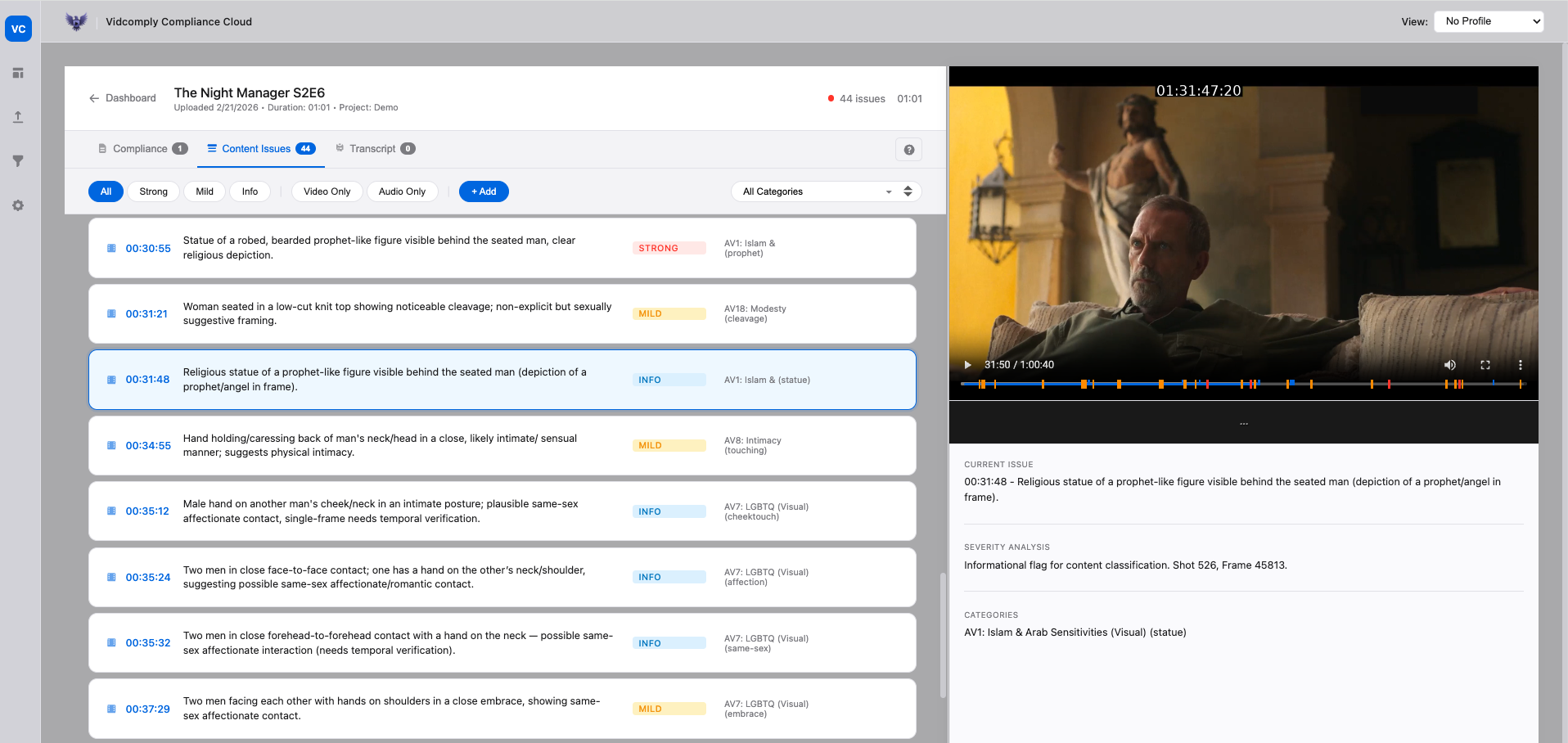
VidComply deployed its Dynamic Global Compliance Platform across the provider's content pipeline. The platform ingested masters and associated subtitle and transcript files, ran multi-layer analysis across picture, dialogue, OCR, and metadata, and surfaced issues into an operator-facing review queue organized by severity, category, and territory profile.
Critically, the platform's profile logic was dynamic — the same content could be assessed against different regulatory profiles simultaneously, with issue queues scoped to the relevant ruleset for each market. When the regulatory environment changed in a territory, the profile was updated once, and the platform could re-assess the affected content without requiring a full re-review from scratch.
"Reviewers stopped watching everything. They started reviewing what the platform had already identified — with evidence, not just a timestamp."
The human-in-the-loop model was central to how the deployment was designed. VidComply surfaces issues and provides the context for a decision. The compliance team makes the final call. Every decision is reviewable, every flag has playback context attached, and the output — a structured compliance report with evidence — becomes an auditable record of the review process.
Faster review. Cleaner records. Scalable without proportional growth.
The primary impact was a change in how compliance reviewer time was spent. Instead of watching content in full across multiple territories, reviewers worked through issue queues organized by the platform. The time spent per title dropped. The consistency of decisions across the team improved — because every reviewer was working from the same evidence rather than from independent watches.
When the provider added a new distribution territory, the compliance workflow extended to that market by adding a regulatory profile — not by hiring a new team member. The platform's coverage scaled horizontally in a way the manual process never could.
The audit trail the platform generates has also changed how the compliance team documents its decisions. Evidence-backed compliance reports replaced spreadsheet notes, making it significantly easier to demonstrate due diligence when regulatory questions arise post-delivery.





Key outcomes
- Multi-territory compliance review from a single operator-facing queue with profile-scoped issue sets
- Review time per title reduced — reviewers work through flagged issues rather than full content watches
- Dynamic profile logic allows regulatory changes to propagate without manual process rebuilds
- Evidence-backed compliance reports replace disconnected spreadsheet documentation
- New territories onboarded by adding regulatory profiles, not headcount
- Human-in-the-loop sign-off preserved — every decision made by the compliance team, not the platform