The "Reality TV" audio bottleneck nobody publishes a solution for.
Unscripted television generates the most chaotic audio data in the world. Reality formats, panel shows, and competition programs routinely wire 20 to 30 participants with lavalier microphones simultaneously. In that acoustic environment, every microphone picks up every other microphone. The result is not just bleed — it is bleed at scale, with destructive phase cancellation that actively degrades the audio quality of the primary speaker.
Before a Senior Dubbing Mixer can make a single creative decision, someone has to fix this. Historically, that someone is the mixer, working through a workflow that looks like this:
- ✗ Scrubbing through the raw session to identify the active speaker on each track, one clip at a time
- ✗ Calculating phase delays between microphones to understand which tracks are cancelling each other
- ✗ Drawing thousands of clip gain automation nodes manually to duck every inactive track during every active moment
- ✗ Sorting raw, undifferentiated audio into organized dialogue, music, and effects stems
"Up to 14 hours of manual data entry per episode — before the mixer can touch a fader for creative reasons."
At that rate, the per-episode audio budget is mostly consumed by prep. The studio is paying senior mixer rates for what is, functionally, data-entry work. That is the bottleneck VidComply was built to remove.
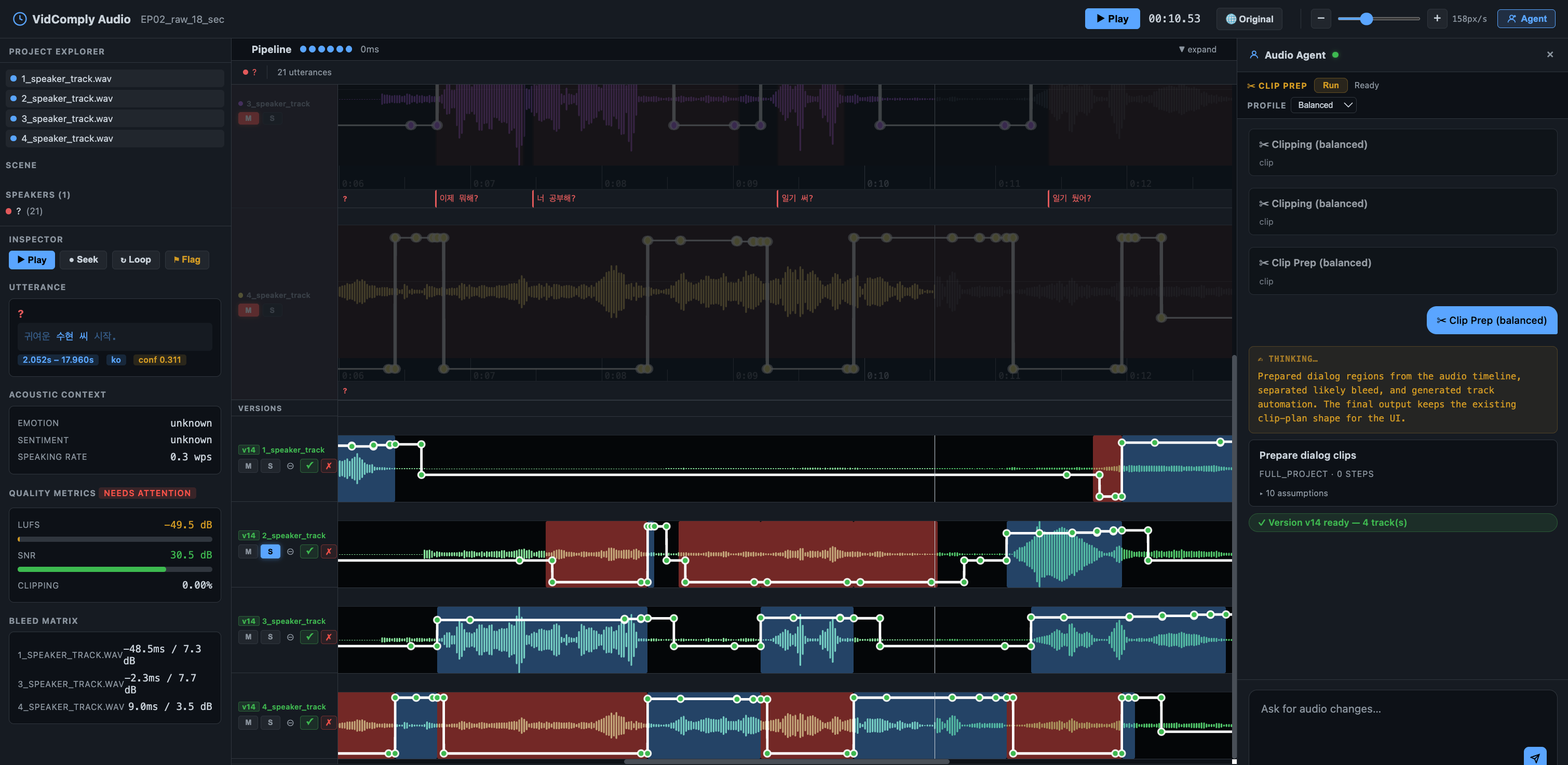
Agentic Automix via AAF integration — zero new tools for the engineer.
VidComply deployed a deterministic AI orchestration node designed specifically for the Stage 1–8 audio prep workflow. The central design constraint was non-disruption: engineers do not change their DAW, their session structure, or their delivery format. The engine slots into the existing Pro Tools workflow via the AAF exchange format — the same handoff mechanism studios already use.
The result is a prep pipeline that eliminates manual audio ducking and track sorting entirely, reducing pre-mix prep time by over 90% per episode.
How the engine works — from raw AAF to clean, prepped session.
Raw AAF export, directly ingested.
The engine ingests the raw Avid Pro Tools AAF export directly. No file conversion, no session restructuring, no new software for the engineer to learn. The session enters the pipeline exactly as it left Pro Tools.
Microsecond phase arrival analysis across all 30+ tracks simultaneously.
The engine analyzes the entire session contextually — not track by track, but holistically. It calculates microsecond phase arrival times and models acoustic attenuation across every track pair simultaneously, producing a full acoustic bleed matrix for the session before any processing begins.
Voice Activity Detection with surgical speaker identification.
The VAD models identify the primary speaker per segment with high confidence, distinguishing human dialogue from environmental noise, cross-talk, and acoustic artefacts. The models are optimized for the specific acoustic conditions of multi-mic unscripted production — not clean studio speech.
Mathematically precise clip gain automation — non-destructive.
Instead of destructive audio rendering, the engine writes clip gain automation data directly. It ducks bleeding microphones, isolates primary dialogue onto dedicated clean tracks, and routes stems according to the studio's delivery spec. Every decision is written as automation nodes — reviewable, adjustable, and fully reversible.
A prepped AAF back into Pro Tools. Every node already aligned.
The system exports a prepped AAF. When the engineer opens it in Pro Tools, every clip gain node, volume normalization, and routed stem is already in place, correctly labeled, and aligned to the session timeline. The engineer opens a session that is ready to mix — not ready to prep.
14 hours of prep. 2-minute GPU compute cycle. Same creative output.
What used to require a senior engineer's full working day — per episode, across every production — is now completed in a 2-minute GPU compute cycle. The session that comes out of VidComply's pipeline is not a rough pass. It is a properly prepared, fully routed, accurately ducked starting point for the creative mix.
Post-production studios reclaim their audio budgets. Senior Dubbing Mixers spend their day doing what they are paid for: making creative decisions. And the per-episode cost of audio prep stops being the line item that makes the production economics difficult.
"The mixer opens a session that is ready to mix. Not ready to prep. That is the entire difference."
What the engine delivers
- Raw Avid Pro Tools AAF ingested directly — no new DAW, no format conversion
- Full acoustic bleed matrix computed across 30+ tracks simultaneously
- Microsecond phase arrival time analysis and attenuation modelling per track pair
- High-confidence VAD distinguishing primary dialogue from cross-talk and environmental noise
- Non-destructive clip gain automation — every ducking decision written as reviewable nodes
- Prepped AAF roundtrip with stems routed, normalized, and labeled to studio spec
- Stage 1–8 audio prep workflow reduced from ~14 hours to ~2 minutes per episode